
Somewhere in the last year or two, a new set of terms landed in the marketing conversation. AI search. AEO. GEO. Generative Engine Optimization. If you’ve been nodding along while privately wondering what any of it actually means — you’re in very good company.
The truth is, most people haven’t had time to understand it yet. The vocabulary arrived faster than the explainer content, and a lot of what’s out there swings between breathless hype and technical deep-dives that require a computer science degree to decode.
This isn’t that. This is a clear, calm look at what’s actually changing, what it means for your brand, and why it matters right now — especially if your work is driven by purpose, not just profit.
AI search visibility isn’t about chasing new platforms. It’s about understanding how answers are formed — and making sure yours are among them.
Search Has Quietly Changed. Like, A Lot.
Here’s the version of search most of us grew up with: you type something in, a list of blue links appears, you click one, you find your answer. It was a ranking game. The goal was to show up high enough that someone would actually click on you.
That’s not how a growing number of people are searching anymore.
AI-powered search tools — think Google’s AI Overviews, Perplexity, ChatGPT, Bing Copilot — don’t hand you a list of links and step aside. They synthesize. They read across multiple sources, form a response, and deliver a summary that attempts to answer your question directly. No scrolling required. No clicking through.
The implication of that shift is significant: being “visible” now includes being understood. It’s not enough to have a page that technically exists on the internet. What matters is whether the content on that page is being accurately interpreted, meaningfully summarized, and surfaced as a trustworthy source.
What This Looks Like in Real Life
Let’s make this concrete. Say someone is looking for a copywriter who specializes in brand storytelling for mission-driven B2B companies. (Sound familiar?)
The old behavior looked like this:
Type “B2B copywriter brand storytelling” into Google. Scan the first page of results. Click on two or three links that look promising. Read the homepages. Maybe save one to come back to. Probably get distracted and forget.
The new behavior looks like this:
Open ChatGPT or Perplexity. Ask: “What should I look for in a copywriter who understands purpose-driven B2B brands?” Or maybe: “How do I find someone who can help my company tell a better brand story?” The AI synthesizes an answer. It describes the qualities, the approach, and maybe even names a few characteristics of the right kind of partner. No list of links. No clicking around. Just…an answer.
I want to linger on that last point for a moment because it’s extremely important. When an AI platform generates a response to a question in your area of expertise, whose ideas is it drawing from? Whose language is shaping the explanation? Whose voice is being treated as the authority?
Right now, for a lot of mission-driven brands, the answer is: not yours. Not because your content isn’t good, but because it hasn’t been built for this environment yet.
Now transpose that onto your own business. Think about the questions your ideal client asks when they’re ready for someone like you. In the old search world, the goal was to show up on page one when they typed those words. In this one, the goal is for your thinking, your voice, and your perspective to be woven into the answer itself — before they ever land on your website.
So What Is AI Search Visibility, Really?
Simply put: AI search visibility is how your brand shows up — and how it’s understood — when AI systems are doing the answering.
It’s not just about whether your website appears somewhere in the results. It’s about three things:
- Whether your brand is being surfaced at all when relevant questions are asked.
- Whether your perspective is being summarized accurately — or oversimplified, diluted, or misrepresented.
- Whether your content is being used as a source that other answers are built on.
This Is Already Happening. It’s Not “Coming.”
It can be tempting to frame all of this as a future concern — something to put on the radar for next year’s strategy. But the numbers tell a different story.
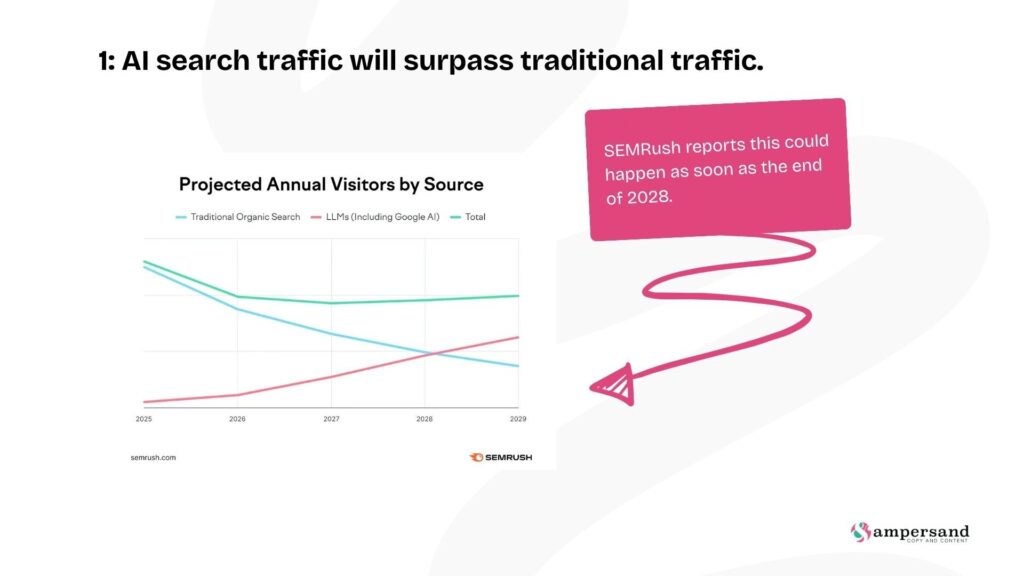
- Gartner projects that by 2028, organic search traffic to websites could drop by 50% or more as consumers shift toward AI-powered search.
- Semrush research suggests AI-driven search could overtake traditional search traffic entirely by the first half of that same year.
And here are the numbers that should stop you mid-scroll:
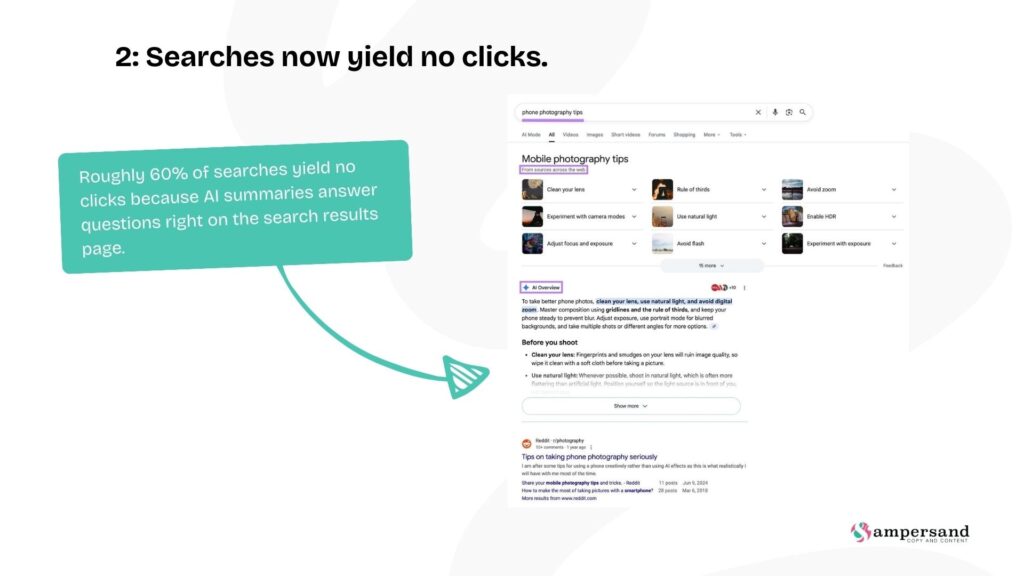
- Roughly 60% of searches on traditional search engines already result in zero clicks. People are getting their answers without ever visiting a website.
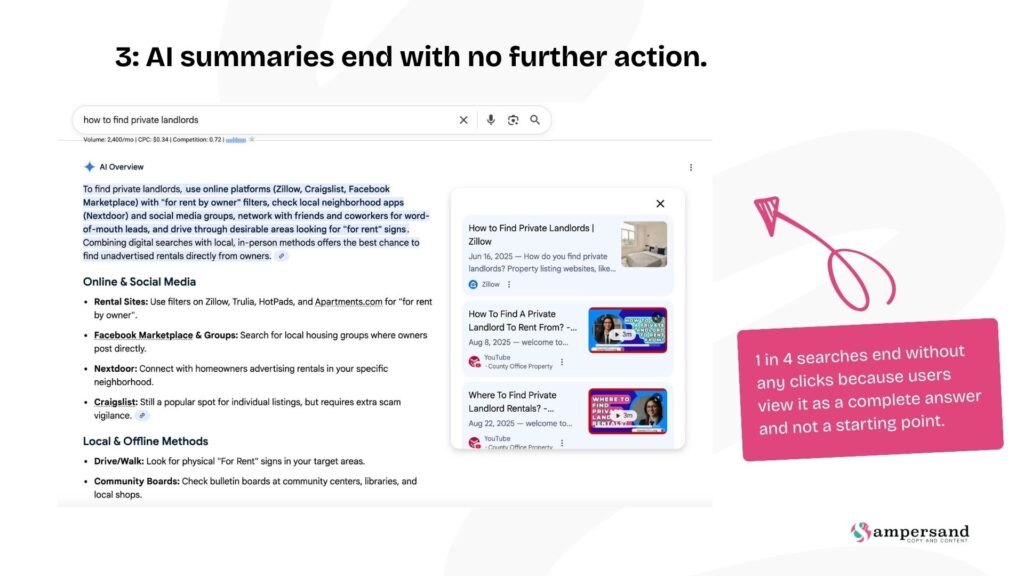
- Add AI summaries into the mix, and that number climbs further — about 26% of searches that show AI-generated summaries end without any further action at all.
- Approximately 50% of Google searches already feature AI summaries, and this figure is expected to rise to more than 75% within just two years.
The bottom line? Users aren’t treating AI answers as a starting point for deeper exploration. They’re treating them as the answer.
Which means the question isn’t whether this shift is happening. It’s whether your brand is ready for it.
You don’t just want to be found anymore. You want to be trusted — and that’s a very different thing to build for.
Why This Is Different from Traditional Ranking
Traditional SEO was a position game. You optimized for keywords, built backlinks, earned a spot on page one, and hoped people clicked. The metric was rank. The win was traffic.
AI visibility is a representation game. The metric isn’t where you rank — it’s how you’re described when you’re not in the room. It’s whether the summary of your work is accurate, resonant, and trustworthy. It’s whether the version of you that AI systems are stitching together from your content actually sounds like you.
Being quoted, paraphrased, and synthesized by an AI system changes the stakes considerably. A misrepresented summary doesn’t just miss the click — it shapes perception. And in a world where trust is genuinely at a premium, perception is the whole ballgame.
What Actually Travels Well in This New Environment
Here’s the good news — and there is genuinely good news here.
AI systems aren’t rewarding brands that stuff keywords into content or game technical signals. They’re rewarding brands that communicate clearly. Brands with consistent narratives across their web presence. Brands whose content sounds like a real human being who knows what they’re talking about.
Clear positioning is easier for AI to summarize. A consistent brand voice is easier to trust and attribute. Language that sounds human — specific, grounded, warm — travels further than mechanical optimization ever did.
That’s a hint at something worth exploring more deeply, the role that storytelling plays in all of this. Not storytelling as a soft, decorative thing. Or a nice-to-have. Storytelling as a strategic signal that tells both humans and machines what your brand stands for, why it matters, and why it should be the voice that gets cited.
We’ll get into exactly how that works and how it compares to traditional SEO in the next post.
Start Here: Understand Before You Act
The worst response to a shifting landscape is panic-driven action. Changing everything without understanding what’s changed. Chasing tactics before you’ve assessed where you actually stand.
The best response — especially for brands with a clear mission and a real story to tell — is clarity first. Know how you’re being perceived. Understand what’s working and what’s getting lost. Then move.
AI search visibility isn’t a threat to your brand’s story. It’s actually an invitation to tell it better.
In a time when trust is at an all-time low, clarity has become a competitive advantage. At Ampersand, we help mission-driven brands strengthen their credibility so their values, expertise, and impact reach the communities they were designed to serve. Not by gaming algorithms. Or chasing trends. It’s by creating brands that sound like humans, but can be understood by machines. If you’re ready to become the answer people trust, contact us today to get started.
Recent Comments